One Script, Half a Continent: The Pallawa Family Tree
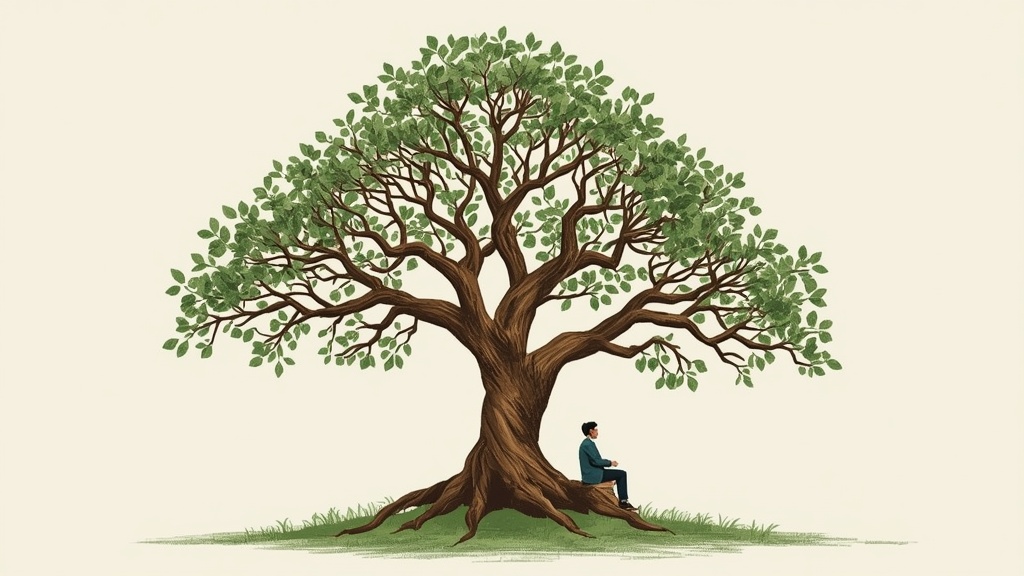
You already know that letters have histories. "Alphabet" comes from alpha and beta, the first two Greek letters. "Rune" originally meant secret or mystery. But here's one you probably haven't thought about: most of the writing systems across Southeast Asia can be traced back to a single Indian script that arrived sometime around the seventh century. One script. Dozens of descendants. Hundreds of millions of people writing in alphabets that share a common ancestor.
That ancestor is called Pallawa, and its family tree is one of the stranger word-nerd rabbit holes you can fall into.
The Trunk of the Tree
The oldest writing found in old Malay dates to the seventh century in Sumatra. It uses Pallawa script, imported from India. Around the same time, the first writing in Khmer also appeared, using an adaptation of Pallawa. Two different places, two different languages, one imported writing technology arriving in roughly the same era.
Then in the eighth century, a new script called Kawi developed, derived from Pallawa, used to write old Javanese. Kawi became the basis for later Javanese and Balinese scripts. Those scripts are still in active use today.
Thai writing came later, originating from Khmer script approximately six hundred years after the first Khmer writing. That means there's a direct line: Pallawa to Khmer to Thai. When you see Thai letters, you're looking at a script with Indian roots, filtered through Khmer, reshaped over centuries into something new.
Philip Bowring, who wrote "Empire of the Winds: The Global Role of Asia's Great Archipelago," traces how this archipelago region (sometimes called Nusantaria) became one of the most linguistically complex places on earth. The Pallawa lineage is a big part of why.
Sanskrit Played the Same Role as Latin
Here's where it gets interesting for word people. Sanskrit served a priestly and official role in this region similar to Latin in medieval Europe. It was the language of power, ceremony, and texts that mattered. You wrote important things in Sanskrit whether or not anyone around you actually spoke it.
The proof is in what actually got borrowed. Only Sanskrit words entered early writing in Java, not Prakrit or other common Indian speech that real people were actually using day-to-day. Prestige language, priestly script. Meanwhile, in Sumatra, Tamil words appeared in early writing, suggesting different trading relationships and different sources of Indian cultural contact.
Same Pallawa script, different vocabulary imports. Language contact is always a story about who was talking to whom.
The Books That Traveled
Two texts in particular made the journey into Nusantarian ruling culture: the Arthashastra and the Manusmriti. Both were widely studied by ruling elites across the region.
The Arthashastra is a fourth century BCE text from the Maurya empire in north India, a civilization that supposedly followed the Jain religion while producing one of the ancient world's most hard-nosed political strategy manuals. (The contradiction is kind of charming, actually.) It covers statecraft, military strategy, economic policy, and law. The ruling elites of Java and Sumatra read it. They weren't just importing a script. They were importing an entire theory of how to run a state.
The Manusmriti covered law and social order. Together, these two texts shaped governance across a region that had its own scripts, its own languages, and its own cultures, but looked to Indian texts for political legitimacy the same way European rulers cited Roman law.
What Scripts Tell You That Words Don't
Here's the thing about tracing script lineages: it tells you something different than tracing vocabulary. Words travel through trade and conversation. Scripts travel when someone decides your language deserves to be written down, and they teach you their system to do it.
The Pallawa family tree spreading from Sumatra to Java to Cambodia to Thailand is a map of who was teaching whom. Of which cultural centers had prestige. Of which texts were worth preserving in permanent form.
Balinese script still in use today connects back through Kawi to Pallawa to India. Thai script connects back through Khmer to Pallawa to India. Six hundred years separated the first Khmer writing from the development of Thai script, but the line is unbroken.
Next time you look at a Thai menu or a Balinese temple inscription and think "I have no idea how to read that," you're looking at a script with a family history that stretches back fourteen centuries to a single Indian ancestor. All those different-looking letters are distant cousins.
Words have histories. So do the marks we use to write them down.
Source: Languagehat