Who First Cut Corners? An Anonymous Horse Fan in Baltimore, 1831
Idioms are liars. They feel ancient. Inevitable. Like they've always been there. "Cutting corners" is one of those phrases. Turns out it has a very specific birthday, a very specific magazine, and a very specific pseudonym.
The First Record: August 1831, Baltimore
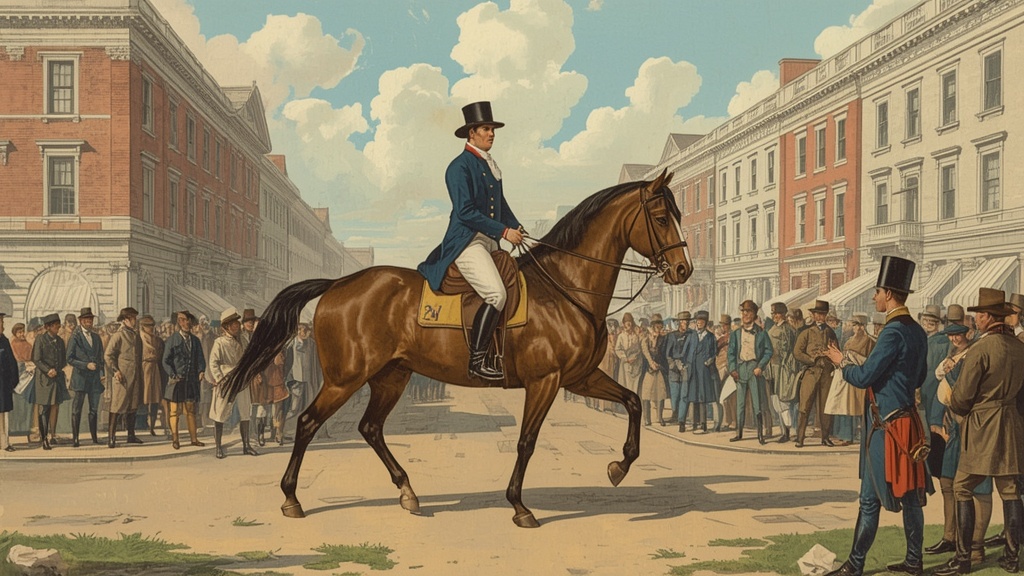
The earliest known written use of "cutting corners" appears in a letter to the editor. The publication: American Turf Register and Sporting Magazine, a monthly out of Baltimore. The date: August 1831.
The author signed it "Tandem."
Not their real name. Anonymous then, anonymous forever. The first person in recorded English to write the phrase, and they chose a pseudonym. One possibility is they had reasons. We'll never know what they were.
What we do know: this was an American invention. Not British. The phrase that sounds like something out of Victorian England was born in a Baltimore horse magazine.
The British Variants
It takes 16 years for the phrase to appear in British print. In 1847, R. N. Hutton (pen name of Charles Henry Newmarch, who also preferred pseudonyms) uses "cutting a corner" in a boating context in Five Years in the East, Vol. II.
Five years after that, William Horlock Knightley drops it in a fox-hunting manual, Letters on the Management of Hounds, in 1852.
Horse racing. Boating. Fox hunting. Three sports, three literal corners, one phrase spreading across contexts because it was doing real descriptive work.
The OED Catches Up (Sort Of)
The Oxford English Dictionary's earliest citation for "cut corners" lands in the 1850s. It comes from a review of Samuel White Baker's Eight Years' Wanderings in Ceylon, published in the New Quarterly Review in 1856.
That's 25 years after "Tandem" in Baltimore. The OED missed the original entirely.
This is not a knock on the OED. It's enormous and indispensable. But it works from submitted citations, and "Tandem's" horse letter didn't make the pile. The earliest OED citation for the figurative sense, where you cut corners to save money or skip quality steps, is later still: the Huddersfield Examiner, a Yorkshire newspaper, July 25, 1868.
That's 37 years after the American Turf Register. Words travel slowly through the record.
Still Cutting Corners in 2013
The OED's most recent citation for the phrase in the "reduce quality to save costs" sense is from The Straits Times, August 23, 2013. A Singapore newspaper.
Baltimore to Singapore. 1831 to 2013. 182 years of the same phrase doing the same job on different continents.
That's what it looks like when a phrase works.
Why This One Survived
The physical image is built in. You can see someone cutting a corner, taking the short path, sacrificing precision for speed. The figurative meaning slots in without translation. The phrase carries its own picture.
Phrases that survive usually do. "Cutting corners" earned its 182 years.
Next time you use it, you can thank an anonymous horse racing fan in 1831 who signed their letter "Tandem."
Source: Grammarphobia