Ha Ha Ha: Why Human Laughter Is the Weirdest in the Ape World
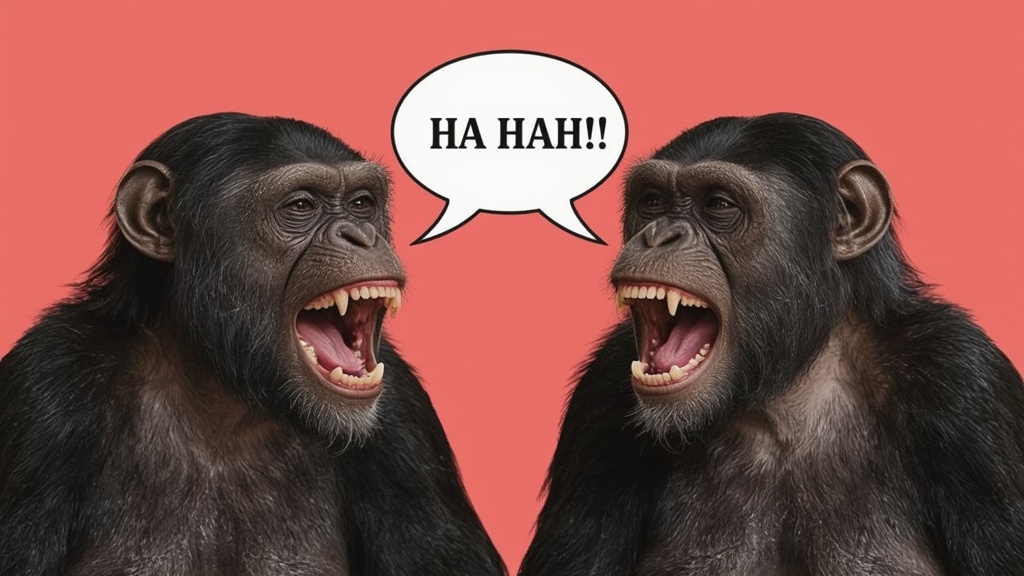
You probably don't think of "ha ha ha" as a feat of vocal sophistication. But compared to how a gorilla laughs? It kind of is.
The Great Ape Laugh-Off
In June 2026, researchers Chiara De Gregorio, Marina Davila-Ross, and Adriano R. Lameira published a study in Nature Communications Biology comparing the laughter rhythm of every extant great ape: orangutans, gorillas, bonobos, chimpanzees, and humans.
What they were measuring was isochrony. That's the quality of being evenly timed, beats spaced at regular intervals like a metronome. If your laughter is isochronous, every "ha" lands on schedule. Predictable. Metronomic. Consistent.
Their finding: the last common ancestor of all great apes was already laughing isochronously. That's the baseline. The starting point. Everyone inherited it.
Then Humans Got Weird
From that isochronous foundation, human laughter evolved to become faster, more variable, and increasingly context-sensitive. The study found a progressive increase in vocal rhythmic plasticity across hominid evolution. Which is a very scientific way of saying we learned to laugh differently depending on what the situation called for.
A polite office chuckle. A startled bark. A slow, helpless wheeze when something is genuinely too much. Humans do all of these. Orangutans are considerably more consistent about it.
This could mean that laughter flexibility co-evolved with language itself. Speech is enormously context-sensitive, and laughter and speech share vocal architecture. One possibility is that as our ancestors developed richer communication, the non-verbal sounds got pulled along for the ride.
The Word Hiding Inside the Study
Isochronous. From the Greek isos (equal) and chronos (time). Equal time. It shows up in music theory, poetry, and linguistics. Some languages are described as isochronous in their rhythm, where beats fall at regular intervals regardless of what fills the space between them.
Word people notice rhythm without always naming it. You feel it when a word "sounds right" in a sentence, when a crossword answer clicks into its slot, when the cadence of a phrase tells you its part of speech before you've consciously processed the meaning. That's isochrony at work, or the breaking of it.
Why This Is a Language Thing, Actually
Laughter might be older than language. But it runs on the same hardware. The fact that researchers can analyze laughter using timing frameworks borrowed from linguistics tells you something about how tangled these systems are in us.
We didn't just evolve better words. We evolved more flexible voices. And those flexible voices do everything: talk, sing, sigh, and apparently laugh in a hundred different registers depending on who's in the room.
One More Thing
The researchers published their data and code. What they didn't publish? The actual audio. Only the timing information made it into the dataset.
So we have the rhythms of every great ape's laughter, mapped and measured. We just can't hear any of it.
There's probably a metaphor in there for crossword clues. All the structure, none of the sound.
Source: Languagelog