Your Ancestors Were Playing Symbol Games 40,000 Years Ago
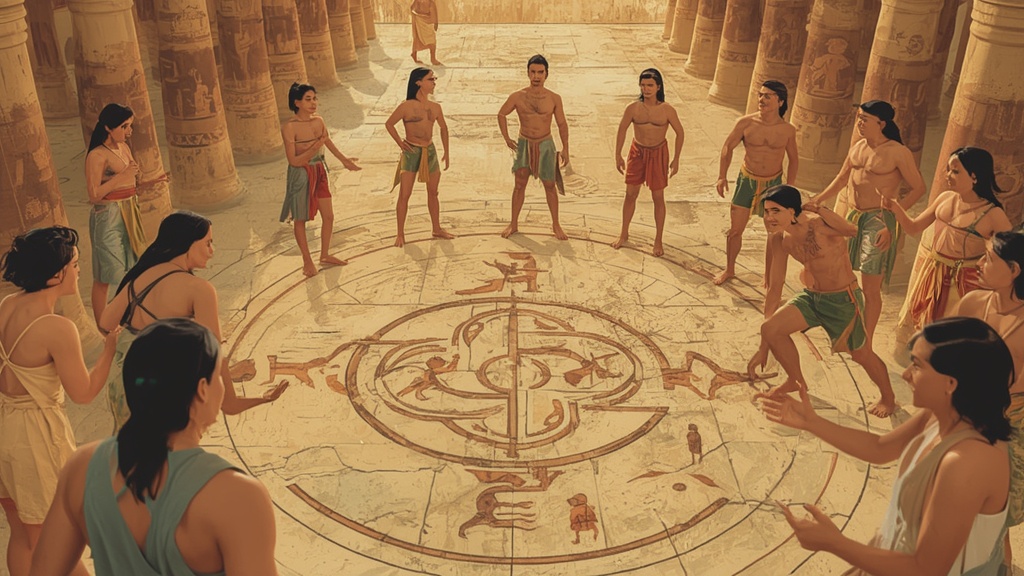
Imagine finding a 40,000-year-old ivory figurine covered in geometric marks. Not random scratches. Not decoration. A system. Statistical patterns that behave the same way as the earliest known writing.
That's exactly what researchers published in the Proceedings of the National Academy of Sciences in February 2026. And it's the kind of discovery that should make every word game enthusiast feel deeply, cosmically vindicated.
The Discovery (Or: We Were Always This Way)
The artifacts belong to the Aurignacian culture, the first modern humans to settle in Central Europe. The assemblage spans from 43,000 to 34,000 years ago and contains more than 200 mobile objects covered in several thousand geometric signs.
Christian Bentz, Ewa Dutkiewicz, and their colleagues ran the sign sequences through the same statistical analysis used on the earliest protocuneiform tablets from ancient Uruk. That's the writing system from roughly 3500 to 3000 BC. The patterns matched. Not similar. Comparable.
In other words: 40,000 years before anyone invented writing, humans were already arranging symbols with the same organizational logic that later produced written language.
The Part That's Genuinely Fascinating
Here's where it gets interesting. The researchers found that signs were applied with higher information density on ivory figurines than on tools.
Think about that. Someone 40,000 years ago was making a choice. This object gets more symbols. This one gets fewer. The figurine matters more (or differently) than the hammer. They were already thinking about what deserves more words.
You do this every time you write a long caption on an important photo and nothing on a boring screenshot. Ancient impulse. Same instinct.
The Codebreaker Connection
Prior research on Europe-wide Paleolithic symbol systems was conducted by researcher Genevieve von Petzinger. Von Petzinger happens to be the granddaughter of a World War II codebreaker who worked at Bletchley Park, England.
There is a family that has, across generations, dedicated itself to deciphering ancient symbol systems. That's either a remarkable coincidence or proof that the love of cracking codes runs deep in some bloodlines.
Possibly both.
How Deep Does "Ancient" Go?
Humans have been carving visual signs into artifact surfaces and cave walls since several hundred thousand years ago. The entire Paleolithic period runs from 400,000 to 15,000 years ago. The new research zooms in on a slice of that: 43,000 to 34,000 years back.
For comparison, the study's analytical dataset covers 89 different languages written in 16 scripts. The full breadth of modern human writing. And the Aurignacian signs still held up statistically against all of it.
What This Means for You
The compulsion you feel toward word games, toward patterns, toward arranging letters just so, is not a quirk. It's 40,000 years of species-level obsession expressing itself through your specific Scrabble tiles.
You're not playing Wordle. You're participating in an ancient tradition of humans staring at marks and trying to make them mean something.
Your ancestors started this. You might as well get good at it.
Source: Languagelog